What Gets Lost When Yoga Comes West
I’ve been feeling a real internal conflict between the yoga I was taught in India and the way yoga is often understood here in the United States.
I’ve been back in the U.S. for around five months now, and I’m currently teaching yoga online and at a local gym. Recently, I was told at the gym, “we do not do chanting.” The more I thought about it, the more I realized it was about more than chanting. On the surface, that may sound like a small thing, but it touches something much deeper…
Yoga has roots in Indian spiritual traditions, including Hindu philosophy. In that context, practices like chanting, breathwork, meditation, mantra, and energy awareness are not separate from yoga. They are part of the path.
In the West, especially in areas shaped heavily by Christianity, yoga is often filtered through a very different lens. For some people, chanting can feel unfamiliar, uncomfortable, or even in conflict with their religious beliefs. I understand this. But I also think there can be a lot of misunderstanding here.
Some Christian communities see yoga as suspicious, foreign, pagan, or incompatible with their faith. Others have adapted yoga into Christian forms of practice. I do not think Christianity itself is the problem. I think the issue is when fear gets projected onto something people have not taken time to understand.
Back to chanting, and specifically AUM chanting. In yogic tradition, AUM is not just a sound. It is a sacred vibration used to focus the mind and bring awareness inward. Whether someone understands that spiritually, symbolically, or simply through the feeling of sound in the body, the intention is connection.
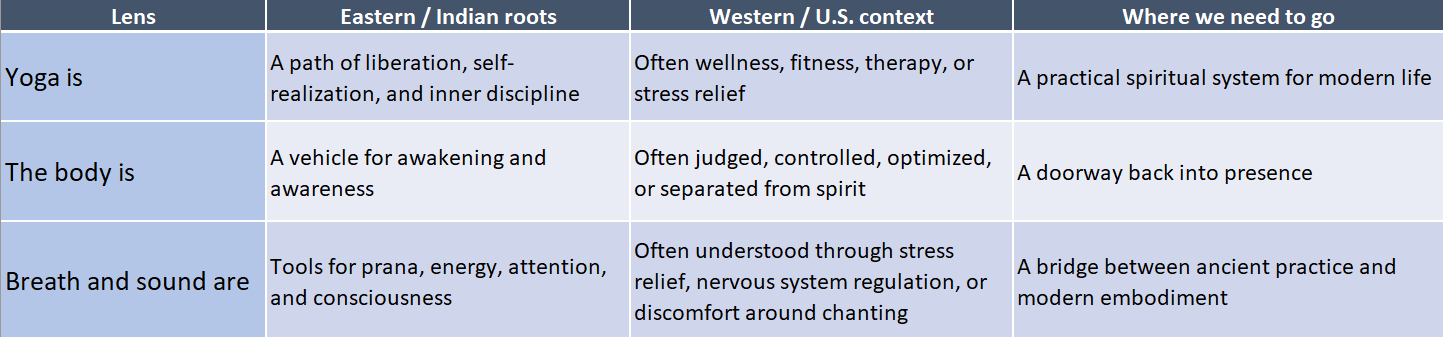
A simple look at yoga’s roots, its Western interpretation, and the bridge forward.
That is why I find it strange when chanting is immediately treated as something dangerous or against God. To me, it feels like the opposite. It feels like a way of becoming more present and more connected to something beyond the thinking mind. These days, we all need to escape the thinking mind whenever possible, lol.
This is where I sometimes struggle with organized religion. This is not because I think the teachings of the church are all bad. Many of them can be beautiful and deeply meaningful. But I do think religious teachings can be misinterpreted. Sometimes people take their own fear or conditioning and project it onto others. That is the part that has angered me in the past, even though I know anger is not where I want to stay. And…I won’t mention Church through the ages.
For me, the deeper work is learning how to separate the wisdom of a tradition from the fear that sometimes gets built around it. Yoga helps me do that.
The Yoga Sutras describe yoga as citta vritti nirodha, often translated as the stilling of the fluctuations of the mind. When the mind becomes quieter, there is more space to notice what is true underneath the noise. The eight limbs of yoga point toward this deeper process. They are not just exercises or lifestyle rules. They are a way of returning to awareness, discipline, and a more honest relationship with yourself.
Maybe the future of yoga in the West is not about choosing one side over the other. It is not about stripping yoga down until it becomes only fitness. It is also not about forcing every spiritual element onto people who are not ready for it.
Maybe the future is a more honest blend.
A yoga that respects where it came from. A yoga that can still speak to modern life. And a yoga that does not shame people for their faith, but also does not erase the spiritual traditions yoga came from.
To me, that is the bridge. A way of practicing that feels rooted, honest, and alive. Something that helps us come back to the body, quiet the mind, and remember the deeper intelligence already within us.